
The stage is Minos — Arknights's answer to Greece. City-states, temples, theater, heroic epics... and disputes settled by arm-wrestling. Literally.
But this romantic nation has a history of being occupied by its neighbor Sargon for over a hundred years. And barely five years after the ceasefire, that same Sargon comes calling for a 'cultural exchange.'
The repatriated artifact the delegation brings is the founding hero Kereseira's lyre. "My lyre rings only for a hero's tale!" — that legendary instrument, exactly as the epic tells it.
1. Madam Ambassador, you're late

Our lead, Titi (whose real name, Mesetiketi Nasutu Masayer, is why everyone just calls her Titi), is the Sargon delegation's ambassador. A fallen noble, a museum director, and a Minos-history nerd down to her bones.
True to her nerd nature, she wanders off from the main party crying, "I want to walk the old road Kereseira once walked!" and gets lost while reciting from a tour guidebook — leaving the 50-kilogram crate of cultural artifacts to be hauled by her sole companion, the beastkin noble Mio. Naturally, they arrive late.
I picked you thinking I'd find some rich enough kid to coast through the rest of my life with — never imagined you'd turn out to be this restless a headache...
— Mio

The boatman Xanthos, who helps them across, is a kind old man handing an apple to a half-dead-with-seasickness Titi.
At the same time, he's also a former guerrilla who lost his most precious friend, Itakos, to the war and hates Sargon to his bones. He doesn't yet know that this Columbia-dressed young woman is the Sargon ambassador.
2. The First Annual First Temple Arm-Wrestling Tournament
Athenus is currently rebuilding the founding hero's First Temple. The slogan: 'pure spontaneity.' Sounds nice, doesn't it? It means no plan and no one in charge.
Naturally, progress is a mess, and orchard farmers stuck waiting on quarrying, and the temple craftsmen, are on the verge of throwing punches. This is where Titi's first act of diplomacy comes in. "Only the winner of an arm-wrestling match gets to speak" — and an impromptu tournament is born.
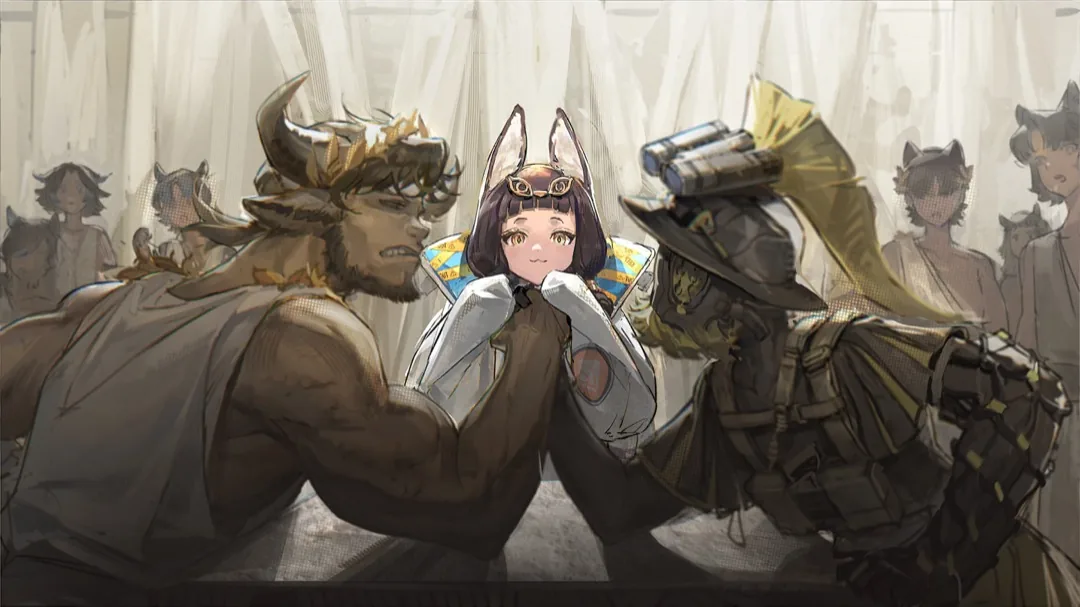
After a few exhausting rounds, both sides finally listen to each other's grievances, and Titi ends the dispute with a bold compromise: "The mountain blocking the sun? Just cut it down. There's marble underneath anyway, so it doubles as a quarry, right?"
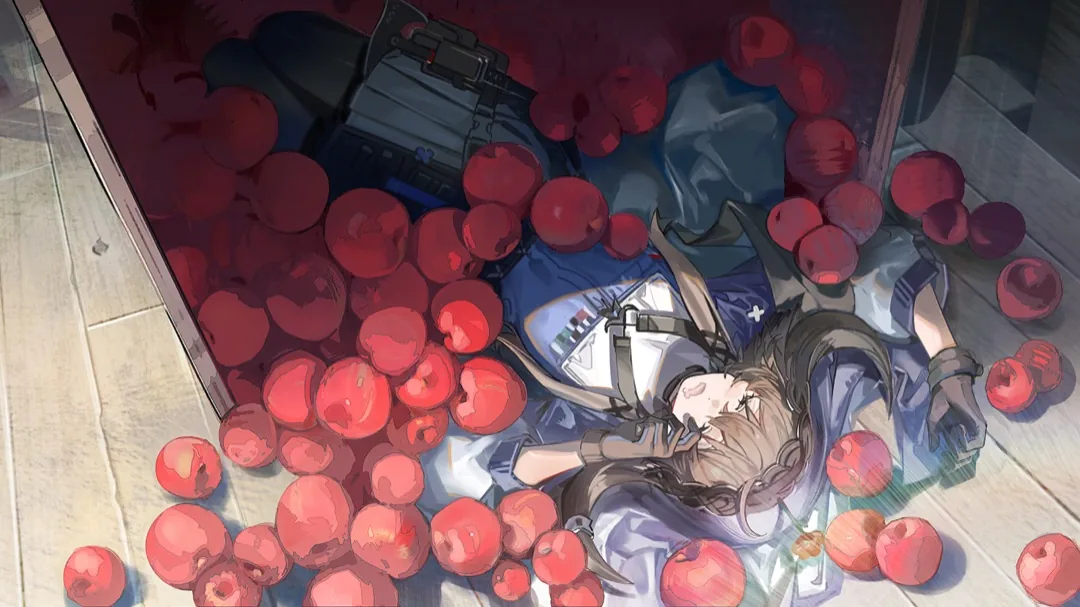
Meanwhile, the reconstruction proposer Pallas, said to have 'gone missing,' is found sound asleep inside an apple crate. Even his sleep-talk manages to worry about both the construction and his apple wine — the man loves his drink.
Sharing a cup with Titi, he abruptly declares them friends... except this man was once known as the 'Goddess of Victory' at the Minos border, a legendary former high priest. Nowadays he's recuperating at Rhodes Island, running little more than a drinking club.
3. The ostracon that gets thrown
At the suggestion of the shrewd city supervisor Lydia (read: political calculation), whether Titi should become the one overseeing the temple reconstruction's final stretch gets put to Athenus's traditional potsherd ballot.
The craftsmen who worked alongside her happily inscribe their yes votes. But then—
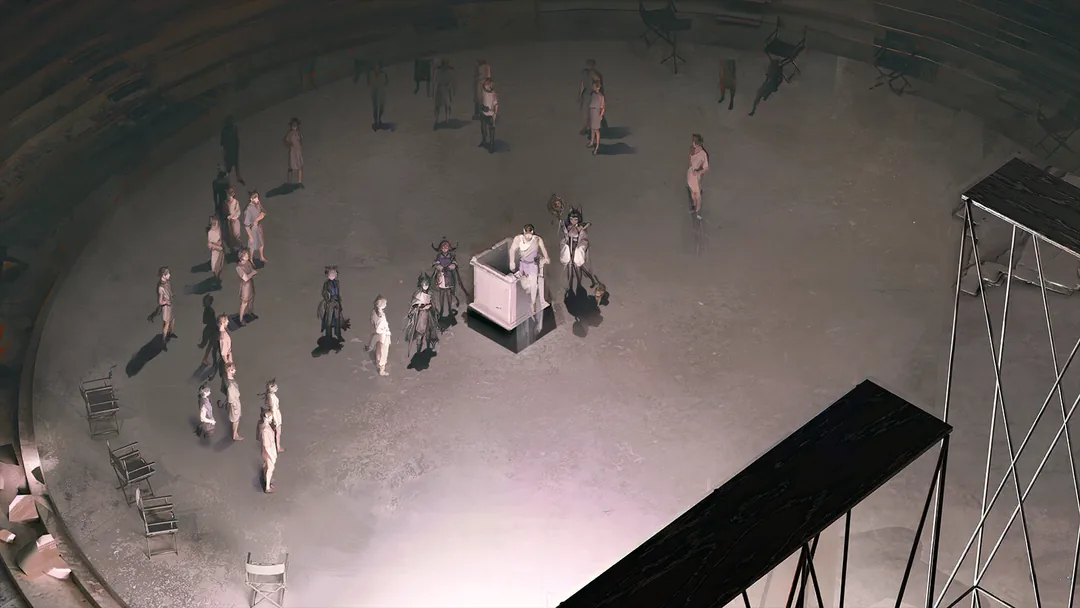
Megas, a former guerrilla living with war trauma, cuts across the plaza. And instead of dropping his ostracon into the jar, he flings it to the ground — meaning it isn't even worth the effort of casting a vote against her.
Titi feels as if she's been slapped. To the craftsmen she'd grown close to, she's 'Titi' — but to a stranger from Minos, she's just a Sargon national from the invader's nation. That day, for the first time, she truly feels the weight of it.

I'll make a special exception. You can pet my tail, mess up my back like you're working off stress, or wipe your tears on my fur. ...Actually, scratch the tears part. I hate getting damp.
— Mio
4. Operation Lyre Heist (culprit: the kind boatman)
Xanthos, having caught on to both Titi's true identity and the artifact's, makes his move. Here's the plan.
His disciple Lykeion rams the hotel kitchen head-on with a supply boat, sparking a fire scare — and in that chaos, Xanthos steals the lyre from a fourth-floor room and leaps out the window. For the record, Lykeion cannot pilot a boat. He failed every single chariot-racing course back at priest school. So that collision wasn't acting — it was raw ability.
A chase erupts along the docks, and the craftsmen, oblivious to what's actually happening, cheer them on: "Is it a footrace? You've got this, miss!" How peaceful...

Luckily, the lyre survives unscathed. Thanks to the excessive padding Titi had wrapped around it before departure — "Even if the building collapses, this lyre stays safe!" — only the stand takes a crack.
Xanthos and Lykeion are arrested. Titi tries to smooth things over — "It's my personal property, a small misunderstanding" — but deputy ambassador Venui politically blackmails Lydia, and the two of them get thrown into death-row cells on charges of treason.
5. But that lyre is a fake
While repairing the crack, Titi notices something. A telltale Sargon drying-prevention treatment left on the cross-section. And Sargon resin from a hundred years ago.
The artifact Sargon brought to return was a forgery. A fake so precise even the Padishah might not have known. When Titi insists the exchange ceremony must be stopped, Venui drops a line for the ages.
What matters at a cultural artifact exchange ceremony isn't the 'artifact' — it's the 'ceremony.' So what if the artifact's fake? It still makes a sound, doesn't it?
— Venui
Titi's conclusion: exposing this as ambassador would spark a diplomatic incident. So, instead, as a private individual, on the day of the ceremony, she'll steal the fake lyre and become a fugitive for the rest of her life. That would also let Xanthos and Lykeion's crimes quietly fade away.
Yes — she has a real gift for cooking up plans where only she loses. As Mio puts it: "That's not the best option, that's just a very 'Mesetiketi' way of solving things!"
6. A silent night

That's when Cassandra, high priestess of the Endymion temple, appears before Titi and yanks a fence post out of the burdenbeast pasture. What had been disguised as a fence post was — the real Lyre of Kereseira.
An instrument that hasn't rung with any string strung on it since the day old Athenus fell — a lyre plunged into silence exactly as the legend says. Cassandra tells her: if she can make it ring, she may take it and complete the ceremony.
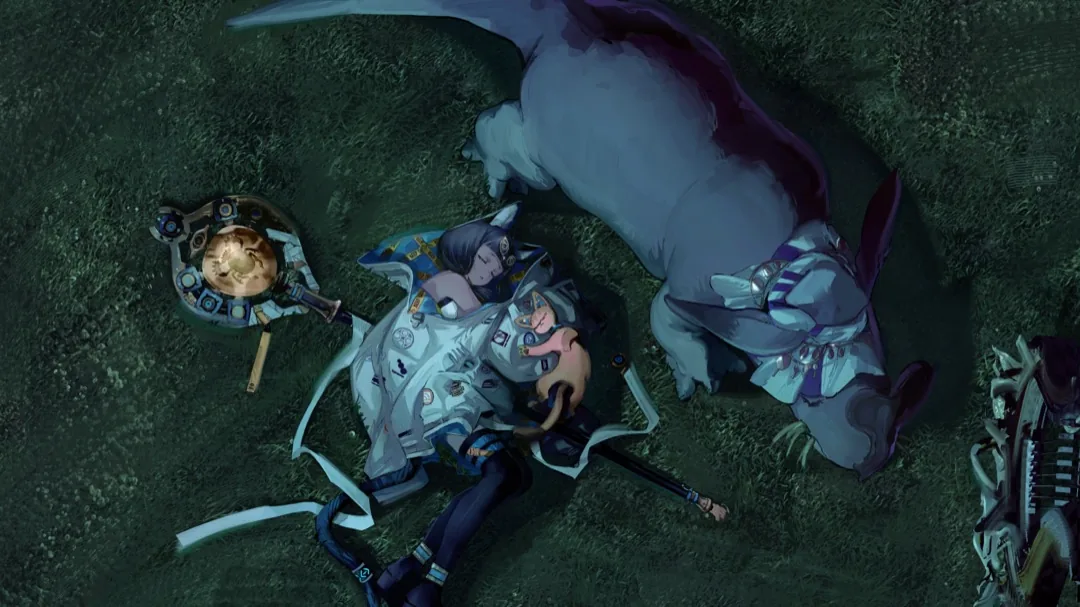
A quick word on her father, from the dream. A fallen house, a feeble man who never accomplished a single thing. Someone the nobles openly mocked, even at his own funeral.
And yet, for some reason, that same father's voice always grew vigorous whenever he told stories of heroes. Sioppi, the hero of silence who kept a secret for thirty years. Kereseira, who refused to play for a stranger. And — "We are all given the chance to become a hero, Titi."
The lyre never rings, in the end. Instead, beside the sleeping Titi, Mio mutters, "Did someone say you need a 'miracle'? That's easy enough!" ...and by morning, dozens of burdenbeasts from the pasture have all escaped. She's the one who caused it.
7. The past of the man with the oar
The scene shifts to death row. It turns out the homeless old man in the next cell is Itakos's father. And here, Xanthos's past finally unfolds.
The friend who'd promised to come home once the war ended never returned, so Xanthos left the village to search for him. For a year, drifting through every guerrilla unit, he tracked down his dead friend's armor, boots, shield, and Arts unit, one by one. And every time he recovered a keepsake, he'd hand it to a fellow soldier — "You need this, take it" — and leave them with the same line.
Countryman — just point me in the right direction.
— Xanthos
Then the old man drops the real bombshell. His grandfather had been a Minosian engineer conscripted for the construction of the nomadic city, and the engineer's notes back then recorded the names and origins of every laborer conscripted by force — a notebook that Sargon confiscated in full.
Which means the 'technical documents' Sargon is trying to reclaim at the ceremony are actually — the original evidence of its own war crimes. The final piece needed to complete the official history that says Padishah Mala never forced Minosians into labor.
8. On the day of the ceremony, the whole city goes wild
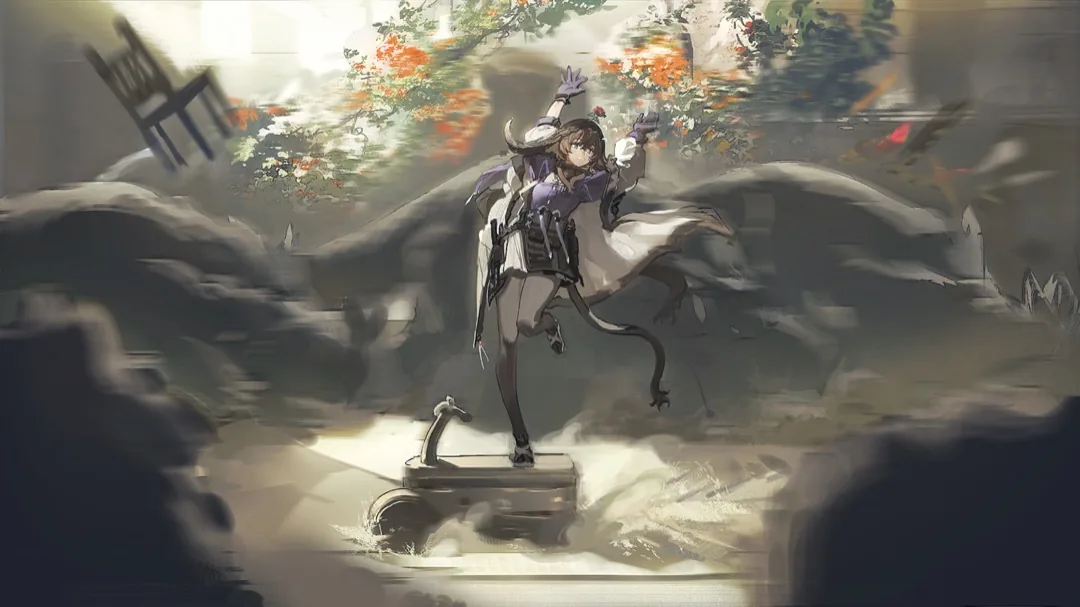
On the day, everything happens at once. The clerk Hekademos, embodiment of clocking out on time, Rhodes Island doctor Rena, and Cassandra conspire to pull off a jailbreak.
But inside the prison, Itakos's father has already provided full service — from the guard shift schedule to unshackling the prisoners — so Hekademos, sneaking in to save them, ends up mistaken for an intruder by Xanthos and gets gagged first. The stampeding burdenbeasts get subdued with a single finger by the taciturn Lacedaemon priestess Siniska (the floor tiles crack beneath her), and the lyre gets safely 'delivered' to the First Temple.

Amid all that commotion, one quiet story shines through. Rena and Lydia, the sisters.
Rena, the older sister who taught the adopted Lydia about gardens. Lydia, who became heir in her sister's place after Rena contracted Oripathy, then gave up both family and inheritance to become city supervisor. "Why do you always have to be so 'great,' sister?" is a complaint, but also decades' worth of longing.
Lydia could have held her sister back, but chose not to. "These ten-odd minutes are the last gift I'll give you. I don't owe you anything anymore."
And later, Rena finds it in the public garden the burdenbeasts trampled through: the pale blue boronia her sister had promised her as a child — "If you ever get lost, come find this flower" — planted throughout the whole garden. — "Thank you, Lydia. I'm home."
The jailbreak crew has one more unforgettable scene. Hekademos and Lykeion. Alongside the truth of the day Lykeion got infected (the culprit who drew the bowstring too hard was Hekademos), their tied three-to-three debate record finally gets settled. The topic of the final debate: "Can the Infected become heroes?"
I'll make you into a hero everyone recognizes as real. And the only 'profit' I want in return is... to beat you in our final debate.
— Hekademos
Lykeion's answer: "...You lunatic." Hekademos's answer: "Thanks for the compliment. Guess that means you agree."
9. A play, a real dagger, and the lyre rings
By Titi's own choice, the opening play of the exchange ceremony is the forbidden classical tragedy no one has staged in a hundred years, Kereseira and the Stranger. Titi, a Sargon national herself, takes on the role of the Stranger. "This is a responsibility I ought to bear as a Sargon national," she says.
But on stage, Titi notices something. The rubber prop dagger meant for the execution scene has been swapped for a real one. The actor playing the soldier is also an unfamiliar face. A murder disguised as an accident.
Titi still... closes her eyes. She chooses to trust her friend.

It's the fugitive Xanthos who bursts in at that exact moment. He kicks away the fake soldier to stop the assassination, and roars out to the entire city from the stage: "What they're trying to take is the record of the blood and sweat we shed building this nomadic city! And all of you who encouraged them are accomplices too!"
Titi's answer to that fury is neither an apology nor an excuse. — "This is a battle I owe you, as a Sargon national." In the middle of the exchange ceremony, a formal duel breaks out between ambassador and boatman.
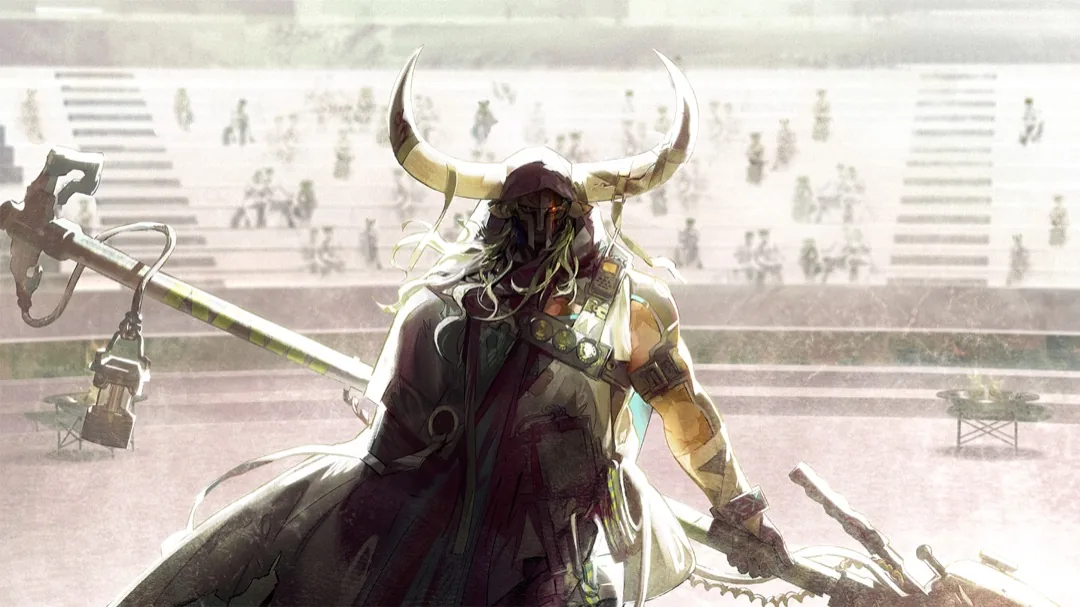
At the end of the duel, Xanthos's blood splashes onto the strings of the real lyre beside the statue. And in that instant — the lyre, silent for a hundred years, rings.
The three of them on stage share a vision of the oracle. What Titi sees is her father's past.
A frail Sargon guard, conscripted to Minos. A man who begged a Minosian prisoner for hero stories every day and copied down over a hundred of them (some of which the prisoner had simply made up on the spot — Sioppi's story was one of those). A man who 'forgot' to lock the cell door, and who 'couldn't help' failing a chase because his armor was too heavy.
An incompetent man repatriated by military tribunal blunder. He was the one who planted the seed of a hero in his daughter's heart. Xanthos tells her, right beside her: "He planted the seed of a hero in your heart."

Xanthos, too, finds his answer within the vision — the reply he could never quite recall, the one he'd given the day he saw Itakos off.
Yeah, but it's fine. Spring will come, and it'll be warmer than before.
— Xanthos
Epilogue: The one who will become Padishah
Titi takes the engineer's notebook back to Sargon in its entirety. Instead of burying it as the Padishah wished, she — puts it on public display as a special museum exhibit, for the entire world to see. She lets the people of Sargon see with their own eyes that their history book is a lie.
Lydia has already prepared full copies of every record, along with papers and even a special issue of a Columbian academic journal. For the record, this city supervisor — despite knowing all about the jailbreak plan — was the type to 'accidentally' leave her keys sitting right on her desk.
Xanthos chooses to submit himself to a citizens' vote rather than face detention. "Whatever the reason, my actions deserve judgment," he says. Titi receives an 'honorary Minosian' medal, along with one suspicious oracle reading from Cassandra: "I believe it was a sign that you are destined to become Padishah."
Three months later, an envoy from the King of Kings arrives at the museum. He wraps up Venui's frantic self-promotion in a single line ("You there, noisy sir, I didn't come here for you") and delivers an invitation to the Golden Citadel — to Titi.
Meanwhile in Minos, the merchant high priest Periandros of Corinia proposes reviving the city-state alliance and a traditional games festival... while Cassandra remains worried about the 'unsettling oracle' Pallas received. The seeds for the next Minos story have already been planted.
To sum it up: the seasick, tardy ambassador became a hero of the very nation her people stole from; the thief who stole the lyre became the one who made it sing; and only the side attempting the real theft — laundering history — walked away empty-handed. Exactly as the epic of Kereseira says. The lyre rings only for a hero's tale.